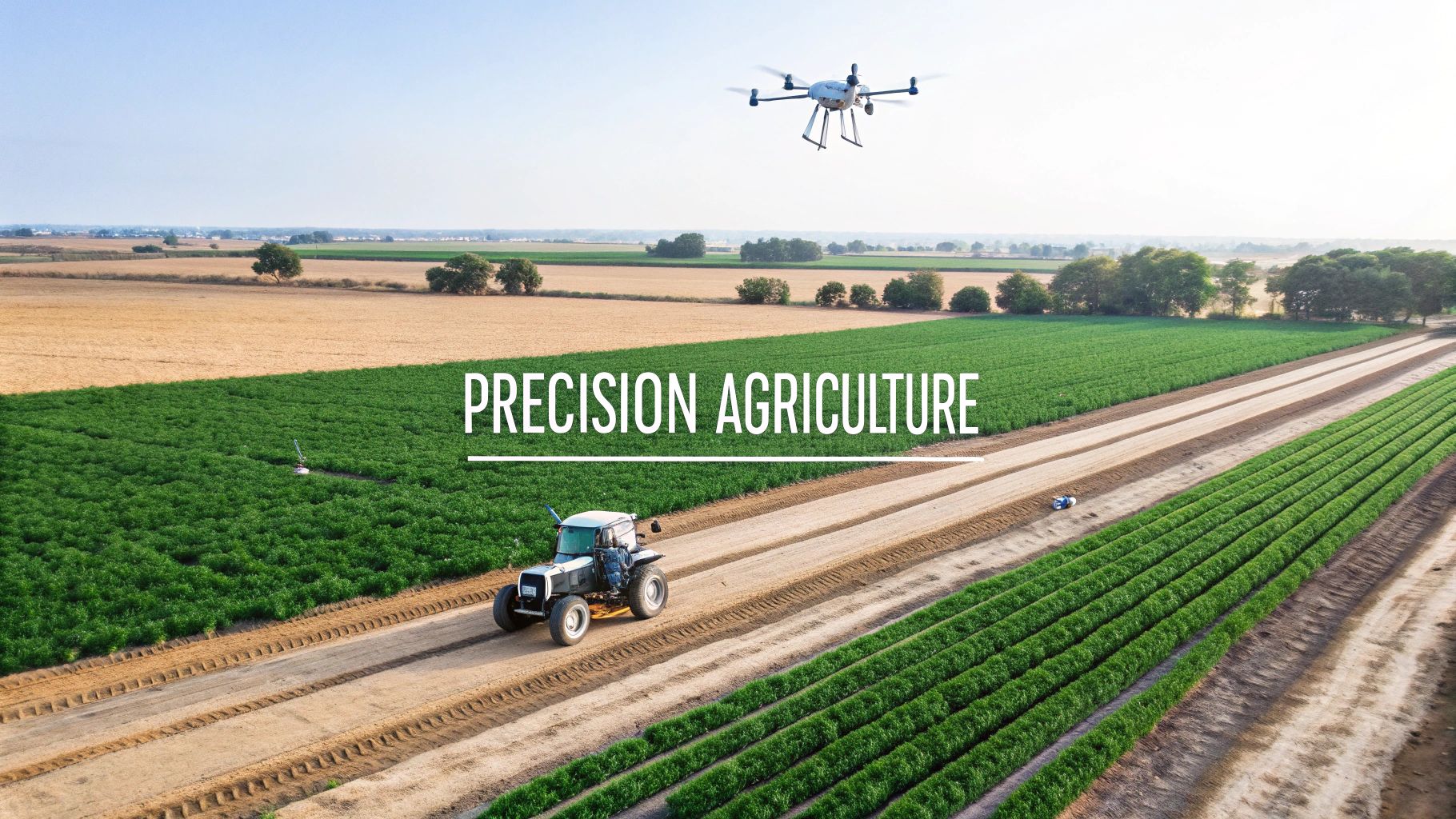
At its core, precision agriculture is a way of farming that uses technology to manage the natural variations you find across your fields. Forget treating an entire field as one big, uniform block. This is about giving every square metre of your land exactly what it needs, no more and no less.
Shifting From Guesswork to Precision
For generations, farming has been a blend of experience, intuition, and a bit of guesswork. We’ve treated fields as single units because, well, that’s all we could do. This traditional approach has served British agriculture well, but it’s an inefficient system. It almost guarantees that some parts of a field get too much fertiliser while others are left wanting, leading to wasted inputs and patchy yields.
Precision agriculture completely turns that old model on its head.
Think of it this way: you wouldn’t buy a “one-size-fits-all” suit for a special occasion. You’d get one tailored. Precision farming is that bespoke suit for your land—every decision is customised, nothing is wasted, and the performance is far superior. It’s about using modern tools to manage the unique needs of different zones, even within the same field.
The Core Principle Making It Possible
The idea behind it all is incredibly simple but powerful: manage the variability in your fields to improve your bottom line and farm more sustainably. Instead of making decisions based on averages, you’re making highly informed choices based on detailed, specific data. This meticulous approach has been steadily gathering pace across the UK for good reason.
This new way of farming uses tools like GPS, sensors, drones, and data analytics to apply the right treatment, in the right place, at the right time. In England, the adoption of these techniques has grown steadily, reaching 27% of farm businesses by 2021—a huge jump from where we were back in 2012. You can dig deeper into these agricultural digitalisation trends in England to see the full picture.
So, how does this all come together on the ground? Let’s break down the key differences between the old way and the new.
Precision Agriculture At A Glance
The table below gives you a quick summary of how precision farming changes the game, moving from a broad-brush approach to one that’s incredibly targeted.
| Concept | Traditional Approach (Whole Field) | Precision Approach (Zonal Management) |
|---|---|---|
| Data Source | Field walking, historical yields, experience | Soil sensors, yield maps, drone imagery, GPS data |
| Decision-Making | Based on field averages and intuition | Based on data from specific zones within the field |
| Input Application | Uniform rate applied across the entire field | Variable rates tailored to the needs of each zone |
| Problem Solving | Reactive; fix issues as they become obvious | Proactive; identify potential issues before they impact yield |
| Outcome | Inconsistent yields, potential for over/under application | Optimised yields, reduced waste, improved profitability |
Essentially, we’re moving from managing fields to managing individual square metres. It’s a profound shift in thinking that puts data at the heart of every decision.
What Does This Mean On The Ground?
So, what does this shift from the traditional to the precise actually look like day-to-day? It’s a continuous cycle of observing what’s happening on your land, measuring it with accuracy, and then responding with targeted action. This constant feedback loop means you get better and smarter, season after season.
At its heart, precision agriculture is about moving from reacting to problems to proactively managing potential. It’s about knowing your fields in incredible detail and using that knowledge to farm smarter, not just harder.
This management philosophy allows you to:
- Identify High-Yielding Zones: You can finally pinpoint the most productive parts of a field and, more importantly, understand why they perform so well.
- Address Underperforming Areas: Diagnose the root causes of problems like soil compaction, nutrient deficiencies, or drainage issues in specific spots and apply the right fix.
- Optimise Input Application: Apply seed, fertiliser, and plant protection products at variable rates. This ensures every part of the field gets the ideal amount, slashing waste and input costs.
By embracing this targeted strategy, UK farmers are finding new levels of efficiency. Their operations are becoming more resilient, more profitable, and much kinder to the environment. In the next sections, we’ll dive into the specific technologies that make all this possible.
The Core Technologies Driving Smart Farming
Precision agriculture isn’t a single magic box you buy; it’s more like a toolbox filled with specialised instruments that work in concert. Think of it as giving your farm a central nervous system. Sensors are the nerve endings gathering information, and software acts as the brain, allowing you to understand and react to what’s happening in your fields with incredible detail.
The absolute bedrock of this entire system is knowing exactly where you are. This is where the Global Positioning System (GPS) and, more importantly, Real-Time Kinematic (RTK) technology come into play. Your standard car satnav gets you within a few metres, which is fine for finding the pub, but RTK refines that signal to deliver centimetre-level accuracy, pass after pass, year after year.
This isn’t just about drilling perfectly straight lines. It’s the key that unlocks controlled traffic farming to minimise soil compaction. It’s what lets you return to the exact same spot for inter-row weeding or to top-dress a crop, season after season. Almost every other precision task builds on this foundation.
Giving Your Farm Eyes and Ears
Once you’ve nailed down your location, the next challenge is to truly understand what’s happening in the soil and with the crop itself. This is the job of a huge array of sensors that act as the farm’s eyes and ears, constantly picking up on details that are invisible to the naked eye.
These sensors come in all shapes and sizes, each with a specific job:
- Soil Sensors: These probes measure critical data points like moisture, temperature, and electrical conductivity, which gives you a solid clue about nutrient levels or soil texture. This information is gold when it comes to making smarter irrigation and fertilisation decisions.
- Crop Sensors: Often mounted directly on tractors, these use light reflectance (you’ll often hear the term NDVI – Normalised Difference Vegetation Index) to gauge plant health as you drive through the crop. They can spot stress from pests, disease, or nutrient shortages long before you’d ever notice it yourself.
- Weather Stations: On-farm weather stations provide hyperlocal data—rainfall, temperature, wind speed—that is far more accurate than a regional forecast. This helps you get the timing of spraying or fieldwork absolutely spot-on.
This constant flow of data from the field fundamentally shifts farming from being reactive to proactive. Instead of just fixing problems you can see, you can start to anticipate and prevent them based on hard evidence.
This diagram shows the simple but powerful cycle that underpins the whole precision farming process.
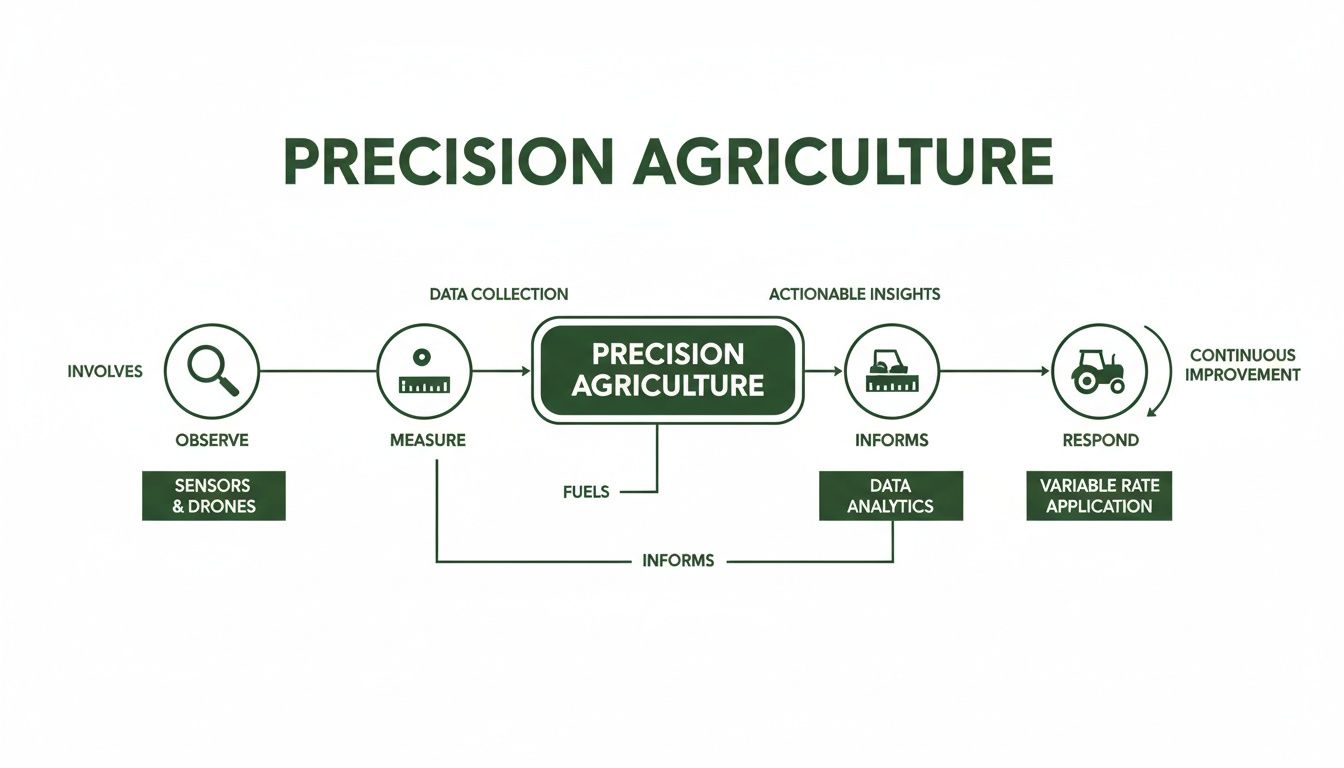
It’s all about observing what’s happening with sensors, measuring that data, and then responding with a precise, targeted action.
Turning Data Into Action
Collecting all this data is only half the job. The real magic happens when you use it to do something differently in the field. This is where Variable Rate Technology (VRT) comes into its own. VRT allows your machinery to automatically adjust how much seed, fertiliser, or spray it applies based on a digital “prescription map”.
This map is created from all the sensor data you’ve gathered. For example, you can combine a yield map from last year’s harvest with a soil sensor map to pinpoint areas with high potential and those that need a bit more help. The VRT system then tells the seeder to increase the seed rate in your best ground and ease off in the poorer spots, helping you get the most out of every square metre.
Among UK farms already using these tools, a massive 80% are aiming to boost productivity. A key part of this is variable rate application, which is already used by 25% of English farms. This targeted approach is a direct route to cutting waste and reining in costs. You can find more data on digitalisation in English farming on Statista.com.
Gaining a Bird’s-Eye Perspective
Sometimes, you just need to get above it all to see what’s really going on. Unmanned Aerial Vehicles (UAVs), or drones, give you an invaluable aerial perspective of your fields. Kitted out with advanced multispectral cameras, they can scout huge areas in minutes, creating detailed maps that highlight everything from crop health and weed pressure to hidden drainage issues.
A drone flight might spot a patch of yellowing crop in the middle of a 40-hectare field that you’d never see from the headland. This early warning gives you the chance to react quickly—maybe with a targeted spray or by taking a soil sample to diagnose a deficiency—saving both time and money.
The real power here isn’t in any single piece of kit. It’s about creating a connected system where data from different sources all flows together, painting a complete and, most importantly, actionable picture of your farm.
Finally, all of this information needs somewhere to live. Farm Management Software (FMS) is the digital hub where all these data streams come together. It’s the place where you can layer up your yield maps, soil data, and drone imagery to see the full story. Good software helps you analyse trends, create those crucial VRT prescription maps, and keep meticulous records for compliance. It’s what turns raw numbers into genuine strategic insight.
How Precision Farming Actually Benefits Your UK Farm
Adopting precision agriculture isn’t just about buying fancy new kit. It’s a fundamental change in how you manage your farm, one that pays real dividends across the board. For UK farms wrestling with tight margins and ever-growing environmental scrutiny, these benefits offer a clear path towards a more resilient and profitable future.
You’ll see the impact in three main areas: your bank balance, your environmental footprint, and your daily workload.
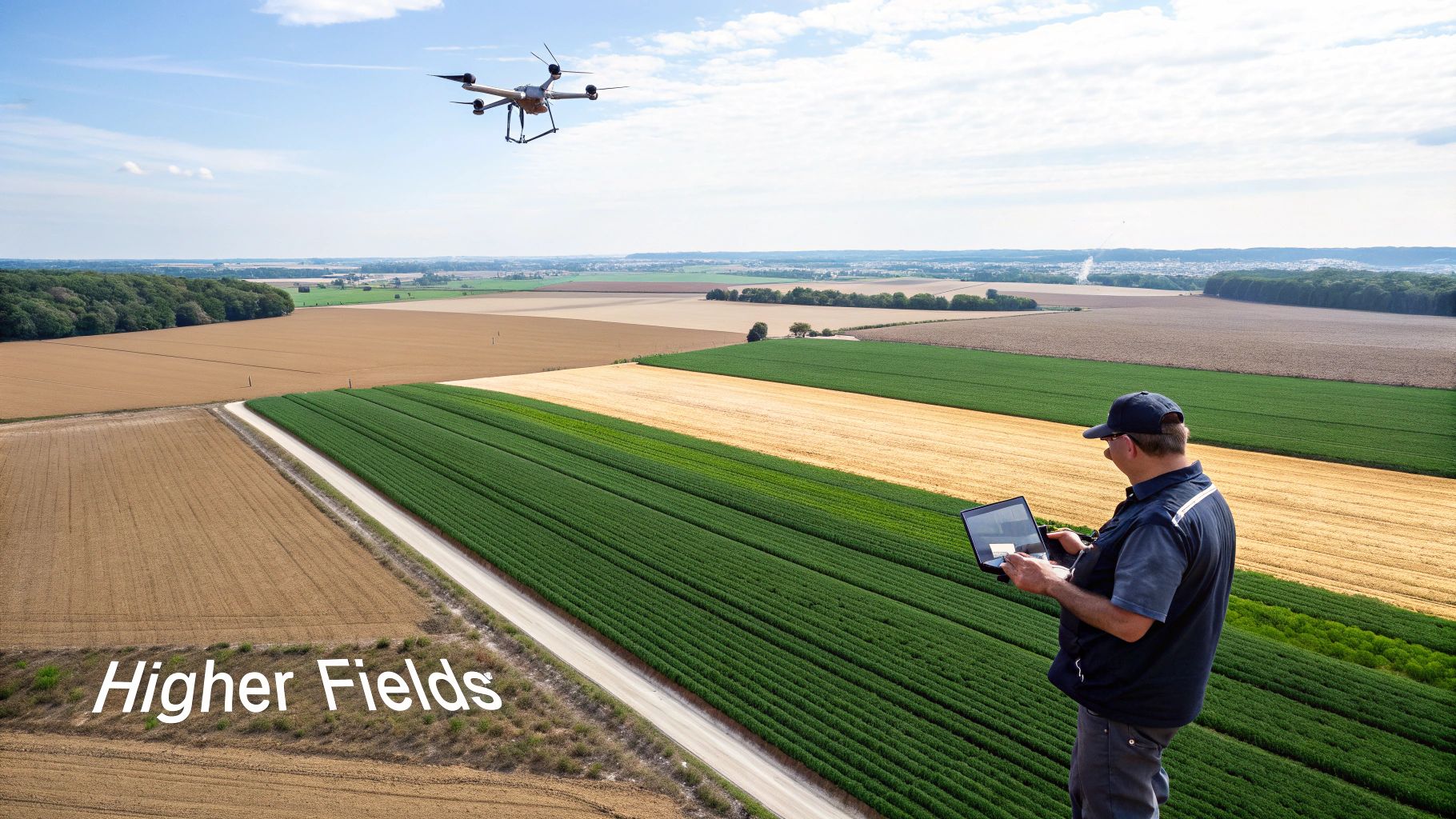
Ultimately, precision farming is about doing more with less. Instead of farming by averages and treating every hectare the same, you’re putting resources exactly where they’ll deliver the biggest bang for your buck. This directly boosts your bottom line while making the whole operation more sustainable.
Strengthening Your Financial Performance
The most immediate and obvious win from precision agriculture is on the financial side. By shifting from blanket applications to a targeted, data-driven approach, you can seriously reduce your spend on key inputs like fertiliser, seed, and sprays. This isn’t about skimping; it’s about eliminating waste.
Imagine applying nutrients only where your soil maps show a deficiency. That alone can slash fertiliser bills. The same goes for seed – adjusting rates based on soil potential means you stop over-seeding poor ground or under-seeding your most productive patches.
But it’s not just about saving money. It’s about making more. By giving each part of a field exactly what it needs, you can lift the performance of those historically disappointing areas and push the potential of your best ground even further.
Precision agriculture directly addresses the two most critical levers of farm profitability: it systematically reduces your cost of production while simultaneously working to increase your total output.
This one-two punch creates a powerful economic advantage, making your business far more robust and better equipped to handle whatever the market throws at you.
Enhancing Environmental Stewardship
Let’s face it, modern farming and environmental responsibility go hand-in-hand. Precision techniques happen to be some of the best tools we have for looking after the land properly. When you apply inputs with surgical accuracy, you massively reduce the risk of chemical runoff into ditches and rivers and shrink your farm’s overall carbon footprint.
The environmental gains are clear:
- Reduced Chemical Use: Spot-spraying or variable-rate applications mean you’re only targeting weeds or pests where they actually exist. This drastically cuts the total chemical load going onto the land.
- Improved Soil Health: Using RTK guidance for controlled traffic farming is a game-changer for soil compaction. Less compaction means better water infiltration, healthier root development, and more life in your soil.
- Lower Emissions: Every optimised pass with the tractor and every bit of reduced fieldwork means less diesel burned. That translates directly to lower greenhouse gas emissions.
What’s more, these practices slot perfectly into the objectives of UK environmental stewardship schemes. This can open up new income streams and proves you’re serious about sustainable farming. It’s a way of thinking that is quickly becoming standard practice. In fact, it’s estimated that over 60% of UK farms will be using precision tech by the end of 2025, driven by this push for sustainability. You can see more data on the UK’s growing precision farming market on Statista.com.
Optimising Day-to-Day Operations
Beyond the balance sheet and the environment, precision ag simply makes the day-to-day running of the farm smoother and less stressful. All that data you’re gathering becomes the foundation for smarter, more confident decisions.
Instead of relying purely on gut feeling, you have hard facts to back up your choices. This helps with managing labour, as jobs can be planned more efficiently. Operators cover more ground with less fatigue, thanks to brilliant tools like auto-steer.
The operational improvements are tangible:
- Better Record-Keeping: Farm Management Software automatically logs every pass and application, creating perfect records for compliance and future analysis without the paperwork headache.
- Increased Efficiency: GPS guidance means you can keep working accurately in fog or fading light, extending your working day and ensuring critical jobs get done on time.
- Proactive Problem-Solving: Data from drones and sensors can help you spot problems like crop stress or drainage issues weeks before they’re visible to the naked eye, giving you time to act before they hit your yield.
This level of insight and control shifts farm management from being reactive to proactive. You’re no longer just putting out fires; you’re planning your season with a much greater degree of certainty.
Your First Steps Into Precision Agriculture
Getting started with precision agriculture isn’t about ripping up your current system and starting from scratch overnight. Think of it as a gradual process, not a flick of a switch. This guide is for UK farmers who are ready to dip their toes in the water, breaking it down into manageable steps that build on each other.
The idea is to introduce new practices in a way that feels natural. This way, you can build your confidence and see a return on investment at each stage without feeling like you’re drowning in technology. The key is to start small, pick a clear objective, and then build from there as you see the benefits stacking up.
Start With a Clear Objective
Before you even think about buying a single piece of new kit, the most crucial first step is to figure out what you’re trying to achieve. A vague goal like “being more efficient” is just too broad to be useful. Instead, find a specific, measurable problem you want to fix.
Maybe you’ve got one particular field that consistently lets you down, or you have a nagging feeling you’re overspending on fertiliser. A much better starting point would be something like: “I want to cut my nitrogen use by 15% on my 40-hectare winter wheat field, without knocking my yield.”
A goal like that gives you a proper target. It makes it far easier to measure whether your new approach is actually working. By zeroing in on a single issue, you can focus your effort and cash where they’ll have the biggest and fastest impact.
Begin With Foundational Technology
Once you have a goal, you can pick the right tools for the job. You don’t need to jump straight to drones and complicated sensors. For most UK arable farms, the logical place to start is with GPS guidance on your tractor.
This is the bedrock technology. It’s relatively straightforward to get the hang of, but it delivers real, tangible benefits almost immediately.
- Reduced Overlaps and Gaps: An auto-steer system or even a basic lightbar ensures every pass is perfectly lined up. That straight away cuts down on wasted seed, spray, and fuel.
- Less Operator Fatigue: When the machine is handling the steering, your operators can concentrate on the implement itself, which improves the quality of the job and makes those long days in the cab less draining.
- Foundation for the Future: Think of accurate positioning as the concrete slab on which everything else is built. It’s the essential first layer for nearly all other precision farming tech.
After you’ve gotten comfortable with GPS guidance, the next logical move is to begin gathering data that actually tells you something meaningful about the variability across your land.
Collect and Understand Your Data
This next phase is about moving beyond just driving in straight lines. It’s about starting to understand why some parts of your fields perform better than others. Two of the most effective ways to get started with data collection are yield mapping and soil sampling.
Yield Mapping: If your combine already has a yield monitor, using it is one of the best things you can do. A yield map gives you a detailed, visual picture of which spots in a field are your most and least productive. This data is gold because it shows you the result of what you’re currently doing and flags up problem areas that need a closer look.
Strategic Soil Sampling: A yield map tells you what is happening, but it doesn’t tell you why. That’s where strategic soil sampling comes in. Instead of taking samples at random, let the yield map be your guide. Pull samples from your high, average, and low-performing zones to see what’s different in terms of nutrient levels, pH, or even soil texture.
By combining yield maps with targeted soil analysis, you stop guessing and start diagnosing. This is the point where you truly begin to build a detailed, data-driven picture of your farm’s unique character.
This approach gives you a powerful evidence base to make smarter decisions. For UK vegetable growers and contractors, this might mean pairing drone data with advanced weeding systems. In fact, some forward-thinking growers are already using drone imagery to guide non-chemical weeders, slashing labour costs and boosting accuracy. You can explore more about the growing trends in English precision farming on Statista.com.
Our own team is constantly working on practical solutions in this area; you can learn more about how we approach innovation and R&D at JF Hudson. This progressive integration of technology is the future of profitable and sustainable farming in the UK.
Putting It All Together: How British-Made Kit Fits Your Workflow
Precision agriculture is ultimately a partnership. It’s the meeting point of smart data and tough, reliable machinery. After all, the most sophisticated digital insights are just numbers on a screen until you have dependable hardware on the ground to put them into action. This is where high-quality, British-engineered kit becomes the backbone of your entire system, turning abstract data into real-world results.
Let’s look at how JF Hudson’s range of durable equipment fits neatly into a modern precision farming operation. From organised storage for delicate tech to getting live data on fuel levels, our products are designed to bridge that crucial gap between your digital strategy and getting the job done in the field.
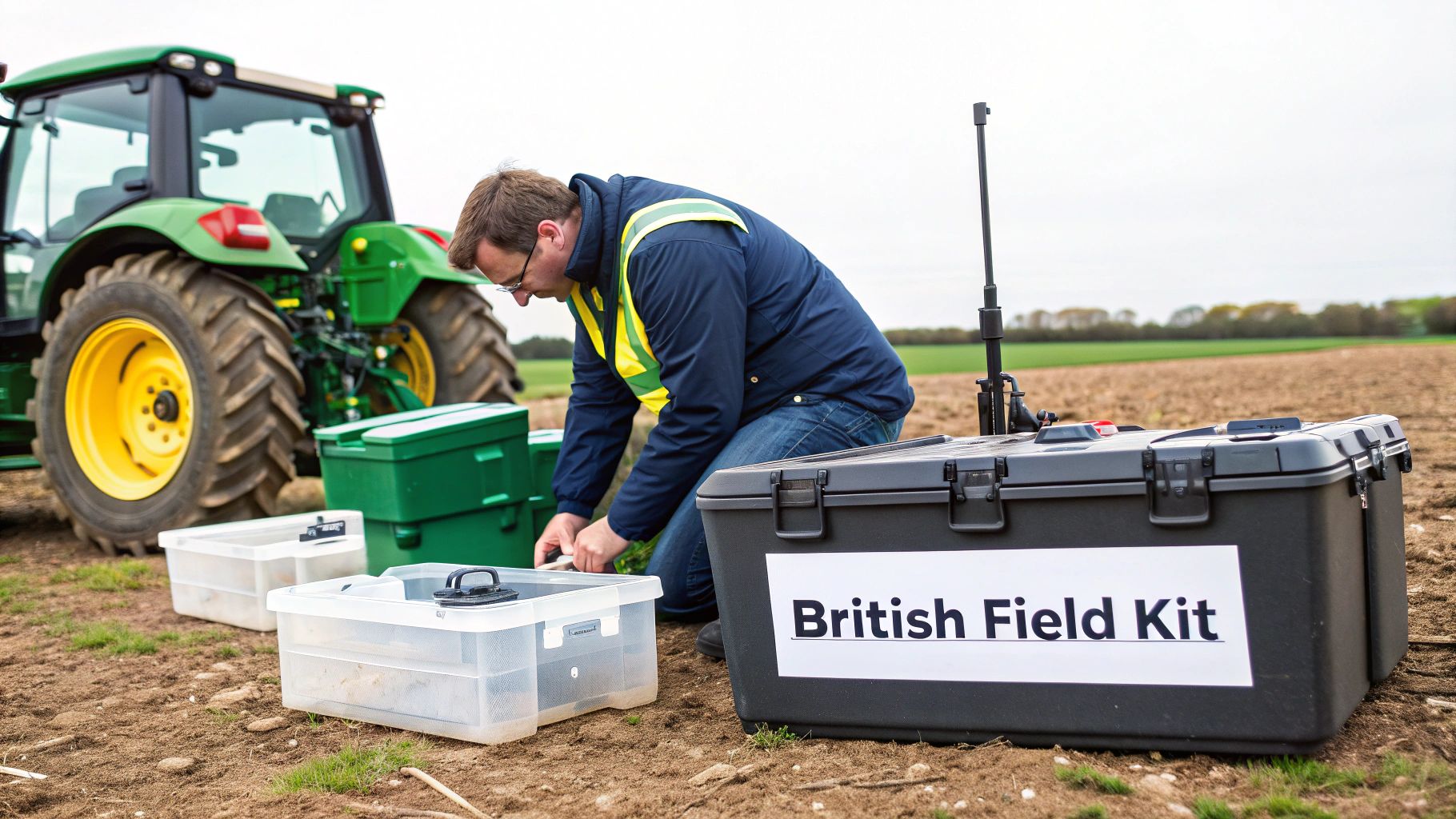
As you can see, our equipment is built for the realities of UK farming, giving you the durability you need to support today’s advanced agricultural practices.
Secure Storage for Your High-Value Tech
One of the most practical—and often overlooked—parts of a precision setup is simply keeping your tools and sensors safe, organised, and ready to go. You can’t just leave delicate soil sensors, calibration tools, and spare parts for your VRT system rattling around in the cab.
Our rugged Front Boxes are the perfect answer. They provide secure, organised storage that shields your essential tech from the bumps and knocks of fieldwork. When you have everything you need stowed safely but still within easy reach, you cut down on frustrating delays and keep your data collection tools in prime condition.
Real-Time Data for Sharper Operations
A huge part of making precision agriculture pay is boosting your operational efficiency. Managing the logistics of a busy farm, especially fuel, is absolutely critical. An empty diesel tank in a remote field during a tight weather window can throw your entire schedule off course.
This is exactly where smart monitoring comes in.
- Automated Alerts: Our system pings your phone directly when fuel levels are running low.
- Data-Driven Decisions: You can track consumption patterns over time, helping you plan refuelling far more effectively.
- Reduced Downtime: It simply eliminates the risk of a tractor running dry, keeping your machinery moving when it matters most.
An Agricultural Tank Monitoring System gives you that crucial, real-time data you need to manage your farm’s logistics. It’s a simple but powerful tool that brings the core principles of precision right to the heart of your operations.
By automating this side of farm management, you free up valuable time and mental energy. Instead of worrying about fuel, you can focus on the bigger strategic decisions informed by all that valuable field data you’re collecting. You can check out the features of our Agricultural Tank Monitoring System here.
Connecting Implements for Precision Application
The real magic of precision agriculture happens when you see a GPS-guided tractor carrying out a task with centimetre-level accuracy. This synergy between guidance systems and specialised implements is where some of the biggest wins are found, particularly in areas like non-chemical weed control.
Our precision inter-row weeding systems are a prime example. They are designed to work hand-in-glove with RTK-guided tractors. This powerful combination allows for incredibly accurate mechanical weed removal right between the crop rows, dramatically cutting down your reliance on herbicides.
It’s a perfect illustration of how smart British engineering brings a precision concept to life, delivering tangible economic and environmental benefits right to your fields.
Overcoming Common Adoption Challenges
Let’s be honest: shifting the way you farm is a big decision, and it’s natural to have a few reservations. Moving into precision agriculture is a significant step, and it’s smart to look at the potential hurdles head-on. By understanding the common sticking points from the outset, you can map out a clear path forward and make your transition to data-driven farming a success.
The first thing on most farmers’ minds is the upfront cost. The price tag on GPS receivers, sensors, and new software can certainly make you pause. The key is to see this as a capital investment, not just another farm expense. It’s a purchase designed to pay for itself through lower input costs and better yields down the line.
The good news? You don’t have to go it alone. A number of government grants and environmental schemes are specifically designed to help farmers adopt more sustainable and efficient practices. These can seriously cushion the initial financial blow, putting top-tier technology within reach.
Tackling the Technology Learning Curve
Another common worry is the sheer complexity of it all. The idea of calibrating sensors, interpreting data maps, and getting to grips with new software can feel a bit much. The trick is to start simple. Choose systems that have a reputation for being easy to use.
You don’t need to become an IT expert overnight. The goal is to find a trusted technology partner who provides excellent training and ongoing support, helping you build confidence one step at a time.
Many farmers find their footing by starting with one piece of kit, like a basic GPS lightbar for guidance. Once you’ve mastered one tool, adding more advanced systems later feels much less intimidating. Insist on good training from your supplier – it’s not a ‘nice to have’, it’s essential and will make all the difference.
Managing Data and Connectivity
The final piece of the puzzle often involves two very practical rural issues: data management and internet connectivity. Precision farming creates a huge amount of incredibly useful data, but it’s only valuable if you can manage it properly.
Here are a few ways to get on top of these issues:
- Data Management: Have a simple plan from day one for how you’ll collect, store, and look at your data. Modern Farm Management Software is built for this, turning raw numbers into visual maps and reports you can actually use.
- Connectivity Issues: Poor rural broadband is a real headache, we all know that. Thankfully, many modern systems are designed to work offline. They can gather data in the field and simply upload it later when you’re back in range of a connection.
Facing these potential obstacles is the first step to beating them. For more ideas on how to bring new systems and processes into your operation without the fuss, you can learn about our approach to farm services and support. With the right strategy and a bit of help, these challenges are just manageable steps on the road to a more efficient and profitable farm.
Frequently Asked Questions
When it comes to precision farming, a lot of UK farmers have questions about what it really means for their own business. Here are some straightforward answers to the questions we hear most often.
How Much Does It Cost to Get Started?
Honestly, it can be anything from a few thousand pounds to a much larger investment. You could start with an entry-level GPS lightbar to get your lines straight and reduce overlaps. On the other end, a full system with auto-steer and RTK (Real-Time Kinematic) accuracy is a bigger ticket item.
The key thing to remember is the grant funding available. It’s well worth looking into UK government schemes like the Farming Equipment and Technology Fund (FETF). These grants can seriously soften the financial blow, making even the more advanced kit a realistic option.
Do I Need to Be a Tech Whizz?
Not at all. The technology behind the screen might be complex, but the systems you’ll actually use day-to-day have become surprisingly straightforward. Any decent supplier will give you proper training when they install the equipment and be on the end of the phone if you get stuck.
You’re also not in it alone. Your farm advisor or agronomist is a crucial part of the puzzle. They can help you make sense of the data coming off your yield maps or soil sensors and turn all those numbers into a practical plan for the next season.
What’s the Best Technology to Start With?
For most arable farms in the UK, the quickest wins usually come from two places: GPS guidance for machinery and basic yield mapping.
GPS guidance is a no-brainer. It immediately cuts down on wasted seed, spray, and fertiliser from overlaps, and it makes a long day in the cab far less tiring. At the same time, switching on the yield monitor that’s likely already in your combine starts building a priceless picture of your farm’s performance, field by field, and even metre by metre. Get these two things right, and you’ve built a solid foundation to add more advanced techniques later.
How Does This Help With UK Environmental Regulations?
Precision farming is one of your best allies for keeping on the right side of environmental rules. When you use tools like Variable Rate Technology (VRT), you’re applying inputs with surgical accuracy—putting exactly what’s needed, right where it’s needed, and nowhere else.
This targeted approach is a massive help in hitting environmental targets. It dramatically cuts the risk of nitrates leaching into nearby watercourses and makes it much easier to meet the demands of new stewardship schemes, like ELMs. You’ll have the clear, auditable data to prove you’re managing your inputs responsibly.
Ready to integrate durable, British-made equipment into your precision farming workflow? Explore the full range of customisable attachments and smart monitoring solutions at JF Hudson Ltd and see how our kit can make your data work harder in the field. Find out more at https://jfhudson.co.uk.